Express Entry without IELTS: what Canada actually accepts
You can immigrate to Canada without ever sitting IELTS, but you cannot immigrate without a language test. Those are two different claims, and pages promising “Canada PR without IELTS” routinely blur them.
Canada accepts four English tests and two French ones, and IELTS is only one of them. PTE Core is now an option and most articles on this topic predate it.
Here is exactly what Canada accepts, the score you need, and the scoring rule that catches people out.
Can you apply for Express Entry without IELTS?
Yes, by taking a different approved test. Language proficiency is mandatory for every Express Entry program. The choice is which test to take, not whether to take one.
| Test | Language | Accepted for Express Entry? |
|---|---|---|
| IELTS General Training | English | Yes |
| CELPIP-General | English | Yes |
| PTE Core | English | Yes, and often overlooked |
| TEF Canada | French | Yes |
| TCF Canada | French | Yes |
| IELTS Academic | English | No |
| PTE Academic | English | No |
| TOEFL | English | No |
That table is the whole answer to the question. If IELTS is the problem, take CELPIP or PTE Core instead. If English is the problem, French is the more interesting option, for reasons below.
One warning about the Academic rows. Students who already sat IELTS Academic for university admission often assume it counts. It does not, and you will need to sit General Training separately.
The score you actually need
CLB 7 in all four abilities for the Federal Skilled Worker Program and for Canadian Experience Class applicants in TEER 0 or TEER 1 occupations. CLB stands for Canadian Language Benchmark, and it is the common scale every accepted test converts into.
| Requirement | Who it applies to | IELTS General Training equivalent |
|---|---|---|
| CLB 7, all four abilities | Federal Skilled Worker, and CEC in TEER 0 or 1 roles | 6.0 in each of listening, reading, writing, speaking |
| CLB 5, all four abilities | CEC in TEER 2 or 3 roles | Lower band scores, check the conversion table |
Results must be less than two years old, both when you create your Express Entry profile and when you submit the permanent residence application.
The scoring rule that catches people out
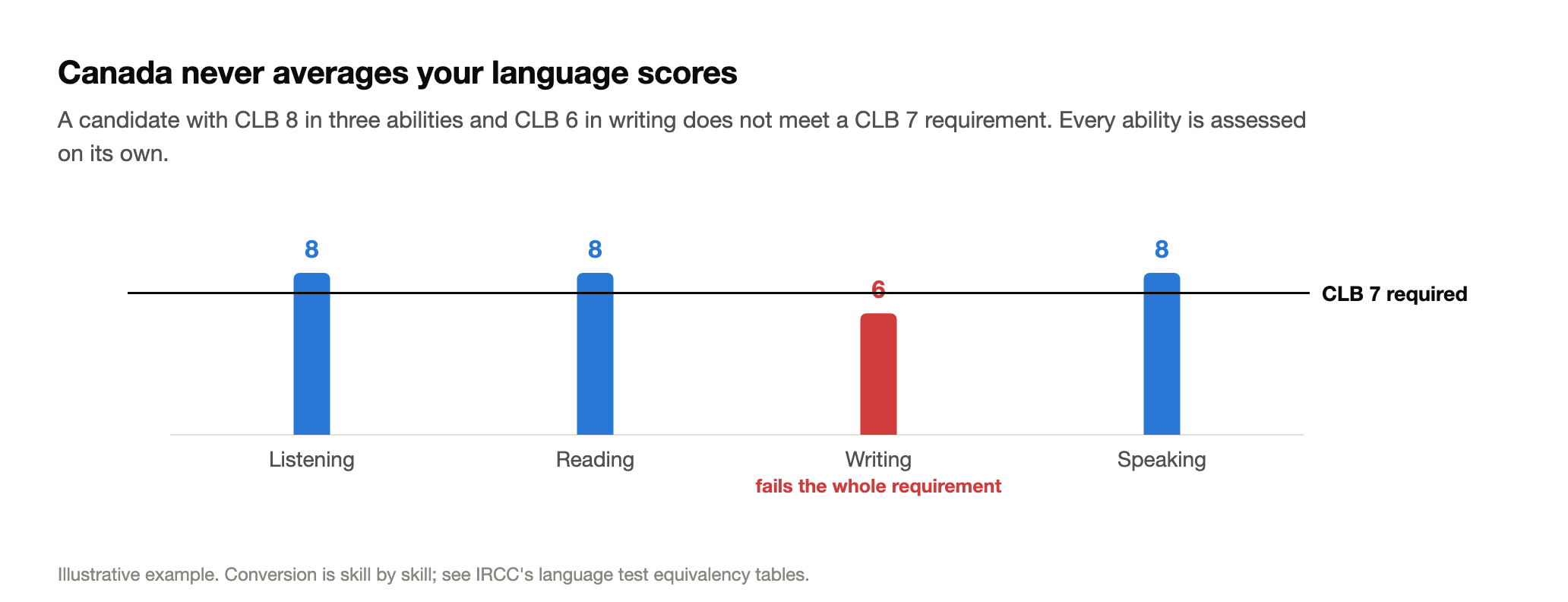
Canada does not average your scores. Conversion happens skill by skill, and you must hit the required level in every one of the four abilities separately.
Here is what that means in practice. If Express Entry needs CLB 7 and you score CLB 8 in listening, CLB 8 in reading, CLB 8 in speaking, and CLB 6 in writing, you do not meet the requirement. Your average is comfortably above 7. It does not matter.
So prepare for your weakest skill, not your overall standard. For most candidates that is writing or speaking, and it is where a retake pays for itself.
French is the underused advantage
For a lot of applicants, yes, and it is the most underused advantage in the system. French-language Express Entry draws have consistently had the lowest CRS cut-off scores of any category, well below the general rounds.
The contrast is stark. Canadian Experience Class rounds ran between 511 and 518 through 2026. Category-based draws routinely cut off much lower, and French has been the most accessible category of all.
French-language proficiency is a continuing 2026 category, and Canada has an explicit policy target for French-speaking immigration outside Quebec. If you have any French at all, from school or from a francophone neighbour country, testing it through TEF Canada or TCF Canada may be the cheapest points available to you.
Reading “PR without IELTS” claims carefully
Read them carefully, because most are technically true and practically misleading. A page titled “IELTS is no longer a hurdle for Canada immigration” is describing CELPIP and PTE Core. It is not describing a route with no language test.
Two specific claims worth checking:
- “Some PNP streams accept lower scores.” Some provincial streams do set requirements below CLB 7. That is a lower score, not no score, and you still need a test result to enter the Express Entry pool.
- “Study permits need no IELTS.” This one is true, and often the source of the confusion. IRCC sets no language requirement for a study permit. Your university does. But a post-graduation work permit does require a test, at CLB 7 for degree graduates and CLB 5 for college graduates.
The old Student Direct Stream did mandate IELTS 6.0 in every band, which is where much of the IELTS folklore comes from. That stream closed on 8 November 2024, along with Nigeria Student Express, so the rule no longer exists.
Frequently asked questions
These are the questions candidates ask most often about language tests for Canadian immigration, including which tests are not accepted.
Can I get Canada PR without any language test?
No. Language proficiency is mandatory for every Express Entry program. You can avoid IELTS specifically by taking CELPIP, PTE Core, TEF Canada, or TCF Canada.
Does Canada accept PTE for immigration?
PTE Core, yes. PTE Academic, no. The distinction matters and booking the wrong one wastes both the fee and the wait.
Is IELTS Academic accepted for Express Entry?
No. Only IELTS General Training is accepted for economic immigration. Academic is for university admission.
What IELTS score equals CLB 7?
6.0 in each of the four abilities on IELTS General Training. All four must independently reach that level, because scores are not averaged.
Which test is easiest for Canadian immigration?
There is no officially easier test, since all convert to the same CLB scale. Candidates often find CELPIP’s Canadian-accent listening or PTE Core’s computer-scored format suits them better than IELTS. Take a free practice test in two of them before paying for either.
Do I need a language test for a Canadian study permit?
Not from IRCC. Your school sets its own admission requirement. A test does become mandatory when you apply for a post-graduation work permit.
How long are language test results valid?
Less than two years old, both when you create your Express Entry profile and when you submit your permanent residence application. Plan the timing so they do not expire mid-process.
Once your test is booked, the next question is which draw you are aiming at. Our guide to permanent residency in Canada covers the 2026 cut-off scores and the categories being invited, and the provincial nomination allocations show where a nomination is most available.
Take a free practice test in CELPIP and PTE Core this week before booking anything. Your weakest of the four abilities decides your result, so find out which one it is first. If you are coming through study rather than skilled work, the study permit route has no IRCC language requirement at all.