
SOP mistakes that get Canadian study permits refused
Do you want to know the single most common reason a good student gets refused?
It is not their English. Four mistakes account for most study permit refusals that trace back to the statement of purpose: no verifiable funding detail, no credible reason to return home, a program that does not follow from your history, or a letter that has obviously been reused.
Here’s what officers flag, how to fix each one, and the short list of tools worth using.
Why do statements of purpose get applications refused?
Because the letter fails to answer the three questions an officer has to decide, rather than because it’s badly written. A polished letter that never names a funding source is weaker than a plain one that does.
| Mistake | How it reads to an officer | The fix |
|---|---|---|
| Funding described in generalities | Unverifiable, and now a direct problem under source-of-funds assessment | Name the sponsor, their business or job, their income, and the amounts |
| No stated plan to return | The applicant intends to stay, and the permit is temporary | Name the sector, the role, and the specific ties at home |
| Program unrelated to your background | The study plan may not be genuine | Explain the change explicitly in its own short paragraph |
| Generic letter reused across universities | Low commitment, possibly an agent-written file | Name courses, faculty, labs, or the co-op structure at that institution |
| Unexplained gaps or a previous refusal | Something is being hidden | State what happened and what has changed, briefly and factually |
The 2026 change to how funding is assessed
Officers now have to assess where your money came from, not just how much of it there is. IRCC updated its instructions to officers on July 24, 2026, and the source of funds must be assessed in every case.
The practical effect on your letter is real. The guidance now points to six months of bank statements instead of four, including the month you apply or the one before. Pension and rental income were added as acceptable sources. A vague sentence about family support no longer clears the bar. There’s now an explicit instruction to trace the money.
Write the funding paragraph so every claim in it matches a document in the same application. If you state a transfer, the statement showing it should be attached. The benchmark you’re writing against is $22,895 in living costs for a single applicant outside Quebec, plus tuition and travel.
How do you write about returning home without lying?
By writing about what’s actually true and specific, rather than making a promise. Canada accepts that students often later apply to stay, so you don’t have to pretend otherwise. What you can’t do is name permanent residency as your reason for coming.
Ties that carry weight are concrete. A family business, property in your name, dependants, a job held open, professional registration at home, or a sector where your new qualification is in demand. Ties that carry no weight are sentiments about patriotism and development.
Compare these two closings. “I am committed to returning to contribute to the growth of my nation” tells an officer nothing. “I will return to Abuja, where I hold a professional registration that lapses if I’m absent more than three years, and where my family runs a logistics business I part-manage” gives them something to weigh.
How do you avoid sounding generic?
Name things that only exist at the institution you’re applying to. If a sentence in your letter would be true of any university in Canada, it’s doing no work.
- Name two or three specific courses from the program’s own course list, and say why they matter for what you want to do.
- Name a faculty member whose work overlaps yours, particularly for research programs.
- Mention the structure if it’s distinctive, such as a co-op placement or a required thesis.
- Cut every sentence about Canada’s quality of life, multicultural society, and world-class education. Officers read those thousands of times a year. They signal a template.
Write a separate letter for each application. An officer uses the section on why this program to judge whether the plan is genuine, so it can’t be recycled.
Three tools worth using, and a warning
Three, and none of them will fix a weak case. A tool can tighten your sentences. It cannot supply the funding detail or the ties that make the letter work.
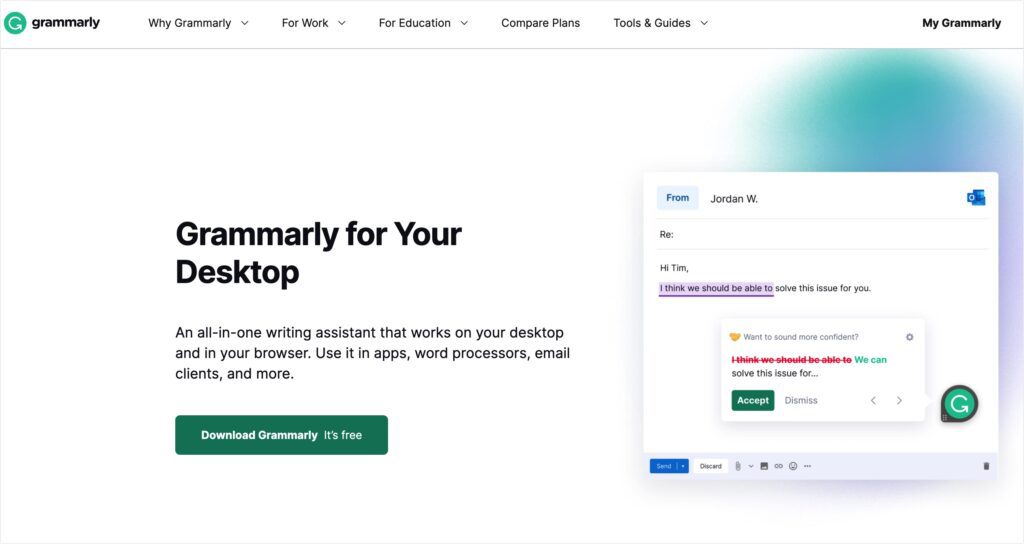
- Grammarly for grammar and punctuation. The free tier is enough for a two-page letter.
- Hemingway Editor to find sentences an officer will have to read twice. Aim for short, plain sentences throughout.
- Google Docs for comments from someone who’ll be honest with you, then export to PDF.
One warning about drafting with AI. A letter that reads as machine-written works against you, and officers see enormous volumes of these. If you use a model to draft, rewrite it in your own words and put your own specific numbers and names in. The detail is the part no tool can invent for you.
A human reader beats all three tools. Give one person your letter and the award or program criteria, and ask them which claims they couldn’t verify.
What should you check before submitting?
Run these five checks on the final draft. Each one corresponds to a refusal ground.
- Every figure in the letter matches a document you’re attaching.
- The sponsor is named, with their relationship to you and their source of income.
- At least two specific, checkable ties to your home country appear.
- At least two details appear that only apply to this institution.
- Any gap, career change, or previous refusal is addressed in one short paragraph.
If you haven’t drafted yet, start with the structure rather than the edits. Our guide to writing an SOP for a Canadian study permit sets out the five sections and shows a weak funding paragraph rewritten.
Frequently asked questions
These are the questions applicants ask most often after a refusal, and before writing a second attempt.
What is the most common SOP mistake?
Describing funding in generalities. Since July 2026 officers must assess the source of your funds in every case, so a sentence about family support with no names or amounts is now a direct problem.
Can a badly written SOP alone cause a refusal?
It can contribute. Officers cite the study plan, funding, and intention to leave as grounds, and the letter is where you address all three. Poor grammar alone is rarely the reason.
Should I use AI to write my statement of purpose?
Not for the final text. A generic machine-written letter reads exactly like the templates officers already reject. Use it to organize your thoughts if it helps, then write the letter yourself with your own figures and names.
How do I explain a previous visa refusal?
In two or three factual sentences. State the ground given, what has changed since, and what evidence you’ve now supplied. Don’t argue with the previous decision.
Can I reapply after a refusal caused by my SOP?
Yes. Read the refusal letter, which usually names the ground, and rebuild that section with verifiable detail rather than resubmitting the same file.
The letter sits inside a larger file. Check it against the full study permit requirements, including the attestation letter, and if funding is still open see Canadian universities that fund international students.
Reread your funding paragraph and ask whether a stranger could verify every claim in it from your attachments. If not, that’s the paragraph to rewrite first.