
7 part-time jobs for students in Canada, and the 24-hour limit
If you’re an international student in Canada, you can work 24 hours per week off campus while classes are in session. On campus, there’s no weekly limit at all.
Those are two separate rules, and mixing them up is how students lose their status. The off-campus limit changed from 20 to 24 hours in November 2024, so much of the advice still circulating online is wrong.
Here’s what you’re allowed to work, what the jobs pay in 2026, and the three rules that catch students out.
How many hours can an international student work in Canada?
You can work up to 24 hours per week off campus while your classes are in session. That limit took effect on November 8, 2024, replacing the old 20-hour cap. You can hold more than one job to reach those 24 hours.
Going over them breaks a condition of your study permit. IRCC is blunt about what follows: you can lose your student status, be refused future study or work permits, and have to leave Canada.
Check your own permit before you take a shift. It has to carry this condition: “May work 24 hours per week off campus or full-time during regular breaks if meeting criteria outlined in paragraph 186(v) of the IRPR.” No condition, no off-campus work.
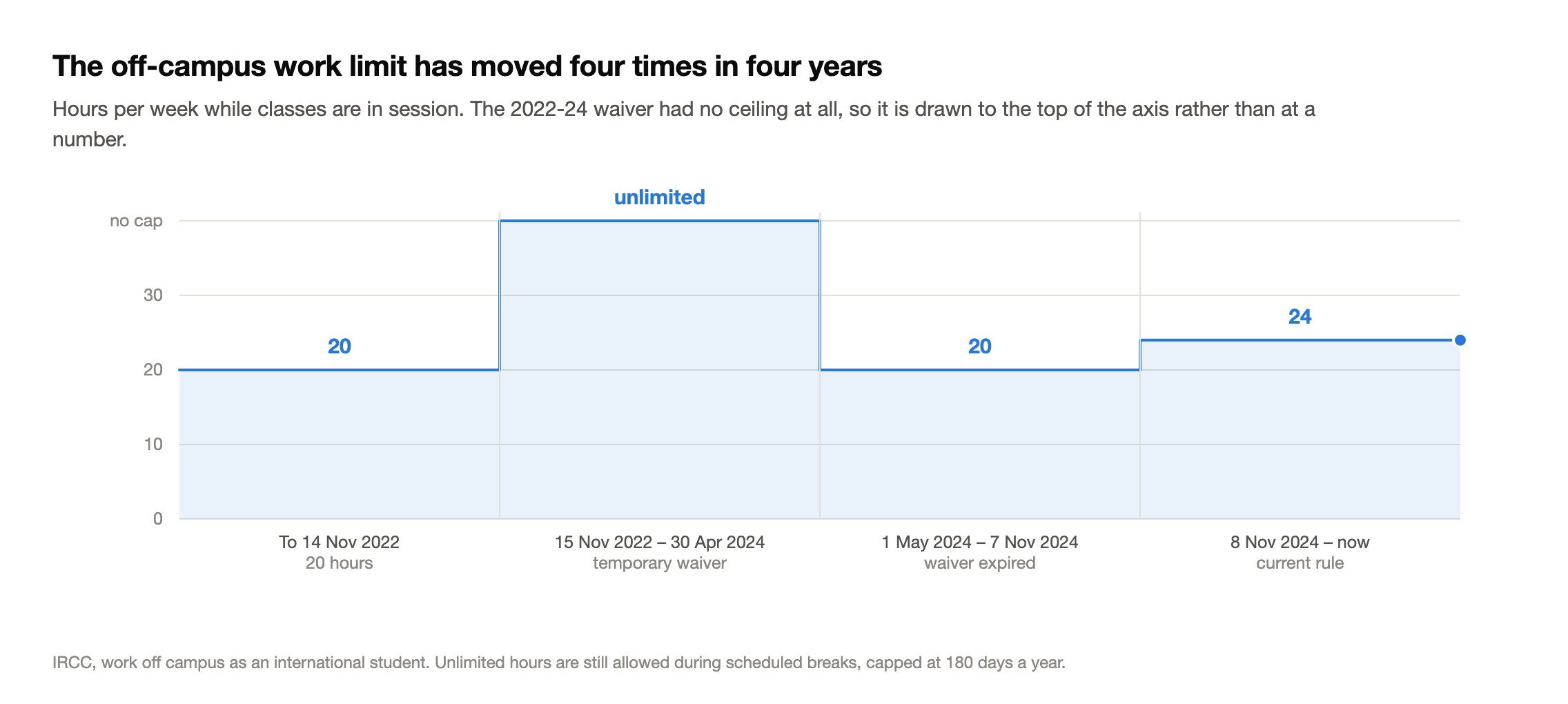
The rule has moved four times in as many years. That’s why student Facebook groups contradict each other:
| Period | Off-campus limit while classes are in session |
|---|---|
| Until November 14, 2022 | 20 hours per week |
| November 15, 2022 to April 30, 2024 | Unlimited, under a temporary policy |
| May 1, 2024 to November 7, 2024 | Back to 20 hours per week |
| November 8, 2024 to now | 24 hours per week |
Can you work full-time during school breaks?
Yes, you can work unlimited hours during a scheduled break. But there’s a ceiling: 180 days of unlimited-hours work per calendar year. That cap counts every regularly scheduled break together, including summer, winter holidays, and reading week.
Almost no guide mentions it. It’s the rule students trip over when they line up a full summer plus a long winter break.
There’s a second limit inside the first. If back-to-back breaks run longer than 150 consecutive days, you can only work off campus during the first 150.
A break also has to be a real scheduled break in your program. You can’t finish a semester, take a term off by choice, and call it a holiday. Working during an authorized leave from studies isn’t permitted.
On-campus work sits outside the 24-hour cap
On-campus work sits under a different regulation, so no weekly hour limit applies to it. If you’re eligible, you can work as many on-campus hours as you want. Those hours don’t eat into your 24 off-campus hours. For a student covering rent in Toronto or Vancouver, that one distinction is worth more than any job list.
Two things have to be true. Your study permit needs the on-campus condition printed on it. You also need a Social Insurance Number, the nine-digit number that lets you work in Canada. Apply for it through Service Canada once you arrive. It’s free.
What are the best part-time jobs for students in Canada?
The strongest options are on-campus roles, tutoring, and required co-op placements. None of those count against your 24 off-campus hours. Retail, hospitality, and care work pay reliably but consume the cap. Here’s how the seven compare.
| Job | Counts toward the 24-hour off-campus cap? | Typical pay in 2026 | What it takes to start |
|---|---|---|---|
| On-campus roles (library, admin, research assistant, tour guide) | No, unlimited hours | Provincial minimum to about $25/hr for research posts | SIN plus the on-campus condition on your permit |
| Co-op or internship required by your program | No, and no weekly limit | Varies widely by field | Must be required for your program and approved by your school |
| Tutoring and teaching assistance | Yes if off campus, no if hired by the school | $20 to $40/hr privately | Strong grades in the subject |
| Retail and hospitality | Yes | Provincial minimum plus tips | SIN, open availability, no experience needed |
| Online freelancing | Yes, and see the caveat below | Set your own rate | A portfolio and a payment method |
| Babysitting and pet sitting | Yes | $18 to $25/hr | References, often a police check |
| Campus ambassador programs | Yes | Stipend or commission | Application through the brand or your student union |
One caveat on freelancing. IRCC counts hours as any time spent earning wages or commission. Self-employed and remote work still count toward your 24 hours, and a client abroad doesn’t change that. Track your hours honestly, because you’re the one who has to account for them.
Do you still need a co-op work permit for an internship?
Not if you’re a post-secondary student. Since April 1, 2026, post-secondary international students no longer need a co-op work permit for a placement their program requires. This is one of the newest changes in Canadian student immigration, and most guides haven’t caught up.
Three conditions still apply:
- The placement has to be required to complete your program.
- Your designated learning institution has to approve it.
- It can’t add up to more than 50% of your total program.
International secondary school students do still need a co-op work permit.
What you’ll actually earn per hour
Most student jobs pay the provincial minimum wage. Where you study affects your income more than which job you pick. The spread between Alberta and Nunavut is nearly $5 an hour for identical work.
| Province or territory | General minimum wage (August 2026) | Next scheduled change |
|---|---|---|
| Nunavut | $19.75 | Indexed each September 1 |
| Yukon | $18.51 | April 1, 2027 |
| British Columbia | $18.25 | Raised June 1, 2026 |
| Ontario | $17.60 | Rises to $17.95 on October 1, 2026 |
| Prince Edward Island | $17.00 | Rises to $17.30 on October 1, 2026 |
| Northwest Territories | $16.95 | Indexed each September 1 |
| Nova Scotia | $16.75 | Rises to $17.00 on October 1, 2026 |
| Quebec | $16.60 | May 1, 2027 |
| Newfoundland and Labrador | $16.35 | April 1, 2027 |
| Manitoba | $16.00 | Rises to $16.40 on October 1, 2026 |
| New Brunswick | $15.90 | April 1, 2027 |
| Saskatchewan | $15.35 | Indexed each October 1 |
| Alberta | $15.00 | None announced, unchanged since 2018 |
Run the math before you rely on the income. At Ontario’s $17.60, a full 24 hours a week comes to about $422 before deductions. That helps with groceries and transit. It won’t cover tuition, and it isn’t meant to. IRCC requires you to prove you can pay for your first year without working, and that proof now sits at $22,895 for a single applicant, on top of tuition and travel.

How do you find a student job without Canadian experience?
Start with your own campus. Those employers already understand study permits and don’t need convincing. Your school’s career portal and student union job board have the highest hit rate, and neither is indexed by the job sites everyone else refreshes.
- Apply for your SIN in your first week. Most employers can’t put you on payroll without it.
- Put your city and your availability at the top of your résumé, not your address abroad.
- Ask your department directly about research and marking work. Those roles are rarely advertised.
- Target the regions where hiring is strongest. Our guide to Canadian regions with the most job opportunities breaks this down by sector.
Keep a record of your hours from day one. A simple spreadsheet is enough. IRCC runs compliance checks on study permit conditions, and “I lost track” is not a defense.
Frequently asked questions
These are the questions students ask most often about working on a Canadian study permit, answered against the current rules rather than the ones that applied a year ago.
Can international students work part-time in Canada?
Yes. With a valid study permit carrying the right condition, you can work 24 hours per week off campus while classes are in session. On campus, the hours are unlimited. You need a Social Insurance Number before you start.
Is the limit 20 hours or 24 hours per week?
It’s 24 hours, and has been since November 8, 2024. Any guide still saying 20 hours is out of date. The unlimited-hours policy that ran from November 2022 to April 2024 has also ended.
Will working part-time affect my study permit?
Not if you stay inside the conditions. Exceeding 24 hours a week off campus breaches your permit, as does working when your permit doesn’t authorize it. That can cost you your student status and future permits.
Do freelance and remote hours count toward the 24-hour limit?
Yes. IRCC counts any time spent earning wages or commission, including self-employment and work for clients outside Canada. Remote work is not a loophole.
How many hours can I work during summer break?
Unlimited hours during a scheduled break, capped at 180 days of unlimited-hours work per calendar year across all your breaks combined. If back-to-back breaks exceed 150 consecutive days, only the first 150 count.
Do I need a work permit for a co-op placement?
Post-secondary students no longer need one as of April 1, 2026. The placement must be required for your program, approved by your school, and no more than 50% of it. Secondary school students still need a co-op work permit.
Can I work while waiting for my post-graduation work permit?
Often yes, if you applied before your study permit expired and you were eligible to work off campus. The rules here turn on your exact situation. Confirm against IRCC’s guidance rather than a forum post.
Before you look for work, make sure the permit itself is solid. Our walkthrough of the Canadian student visa application covers the attestation letter and proof-of-funds rules that decide the outcome. The statement of purpose guide covers the document most applications are refused on. If you’re still funding your studies, start with the Canadian universities that fund international students.
Check your study permit for the exact work condition printed on it, then apply for your SIN. Those two steps decide what you’re legally allowed to earn.